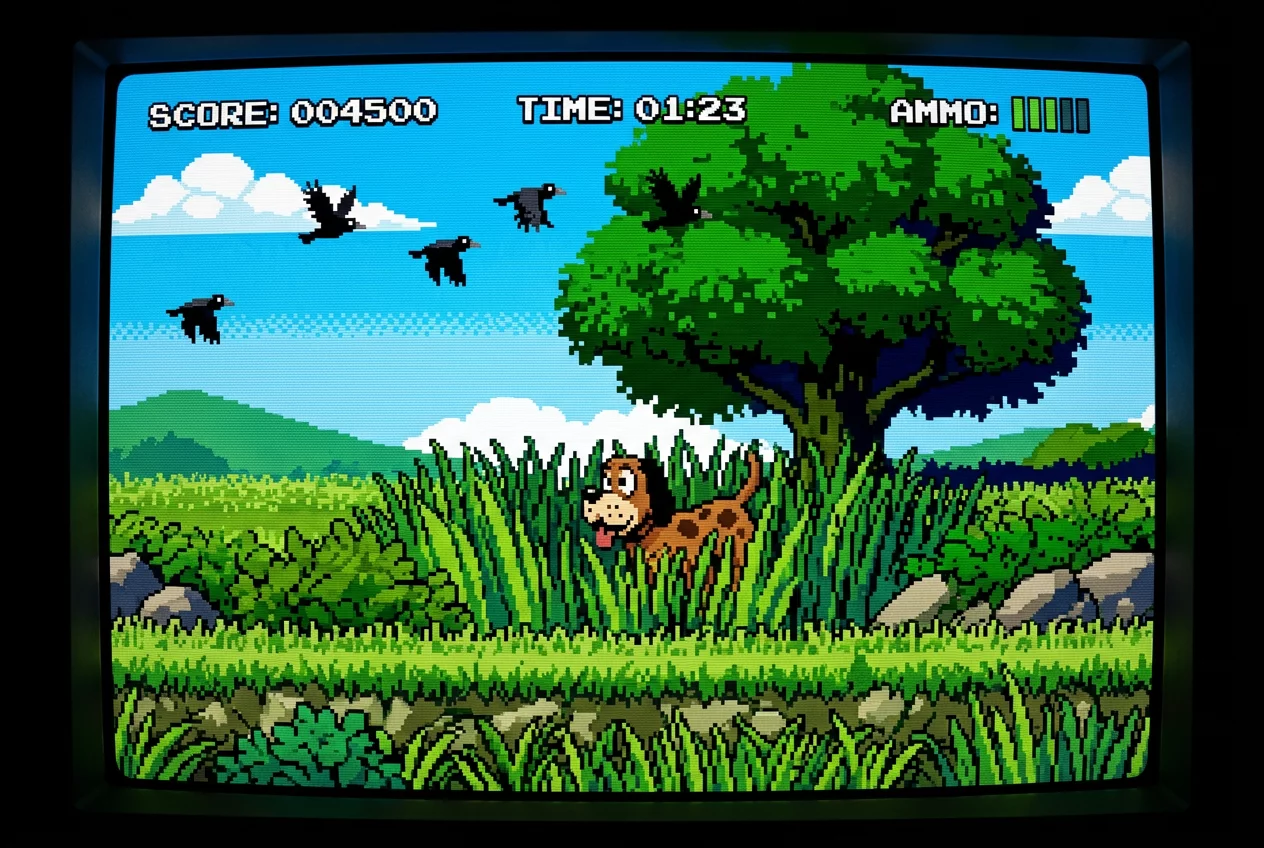
The 8-Bit Marshland Legacy
Duck Hunter Legends stands as a testament to the simplicity and ingenuity of early home console entertainment. Released during the golden age of the 8-bit era, it transformed living rooms into virtual hunting grounds using the revolutionary light gun technology. Even today, the vibrant blue skies and pixelated marshlands evoke a powerful sense of nostalgia for those who grew up clutching the gray plastic Zapper. It is arguably the crown jewel of the light gun genre, setting a standard for precision and reaction-based gameplay that many modern titles still struggle to replicate.
The atmosphere of the game is deceptively serene. Before each round, the player is treated to a peaceful view of the marsh, complete with gently swaying reeds and distant pixelated clouds. This tranquility is shattered the moment the first duck takes flight, transforming the scene into a frantic test of reflexes and accuracy. The contrast between calm and chaos is a deliberate design choice that heightens the tension of every shot.
What makes Duck Hunter Legends truly remarkable is its accessibility. Unlike complex role-playing games or demanding platformers, this title requires no tutorial or manual. You point, you shoot, and you either hit or miss. This simplicity made it a favorite among players of all ages, from young children trying the Zapper for the first time to experienced gamers competing for perfect rounds.
Gameplay Mechanics and the Zapper
The core experience of the game relies on the player's reflexes and the calibration of the hardware. The gameplay loop remains deceptively straightforward yet endlessly challenging. Whether you choose the single-duck mode or the chaotic two-duck frenzy, the pressure builds with every flapping wing. Every shot counts, and the satisfaction of a clean hit is immediately met with the next wave of targets. The game successfully creates a "one more try" loop that kept players glued to their CRT screens for hours, aiming for that perfect score.
Technical limitations of the original hardware actually enhanced the charm of the experience. The Zapper worked by detecting flashes of light from the television screen, meaning that older CRT displays were essential for accurate targeting. This dependency on specific technology gave the game a physical, tactile quality that modern motion controls often fail to replicate. The weight of the plastic gun, the satisfying click of the trigger, and the immediate audio feedback formed a sensory experience that remains unforgettable.
The Infamous Laughing Dog
No discussion of this title is complete without mentioning its most famous character: the hunting dog. While he is your companion, his mocking laugh whenever you miss a target has become one of the most iconic and frustrating sounds in gaming history. This psychological element added an extra layer of tension to the hunt. While the original hardware required a specific type of television to function, many enthusiasts now look for ways to experience this classic through various emulators and browser-based archives to relive that competitive spark and finally silence that dog's giggle.
The dog has transcended the game itself to become a pop culture icon. Memes, remixes, and references to his mocking laughter appear across the internet decades after the game's release. This unexpected legacy speaks to the emotional power of simple character design. The dog does not speak, does not move much, and serves no mechanical purpose—yet he is remembered more fondly than many fully voiced protagonists.
A Lasting Impact
Mastering the rhythm of the game requires patience and a steady hand, proving that true legends never really go out of style. It paved the way for future shooting games and remains a staple in retro collections worldwide. Its presence in the arcade scene and the home market solidified its place in the history books, reminding us that sometimes the simplest concepts are the most enduring. Whether you are a veteran marksman or a newcomer, the marsh calls to everyone.
The influence of Duck Hunter Legends extends beyond the light gun genre. It demonstrated that peripheral-based gaming could create unique, memorable experiences that standard controllers could not replicate. Modern virtual reality shooters owe a conceptual debt to this humble 8-bit title, which proved that aiming at the screen with a physical prop creates an immersion that buttons alone cannot match.
Player Reviews
ZapperKing
2026-06-10That laughing dog still haunts me. Every time I miss, I can still hear that sound in the back of my head.
LightGunFan
2026-06-12A true masterpiece. It's the reason I still keep my old CRT around. You can't beat the Zapper feel.
Leave a Review